Go to Frank's home page by clicking below

Tuesday, September 20, 2011

Three Employee Types


Minders, Finders and Grinders
While at sea in the Navy, (which seemed to be forever) they offered college credit courses. During one of the Principles of Management classes the professor mentioned that there are three employee types, Finders, Minders and Grinders. The Finders were the savvy customer oriented, sales type folks who weren't that great technically, but everyone loved them. The Minders were the great coaches, leaders, spokespeople and supervisors. Great Minders were process-oriented and dedicated to making the team work well together. The Grinders were the highly technical yet customer unfriendly types. They did great as long as they were left alone and required little communication with others. Most people are a mixture of all three with certain characteristics that make them stronger in one of the areas. What I have found during my many years of management in Sony, RCA and GE, is that when you have someone who is very strong in one of the categories, they are usually weak in the other two.

It takes a great manager or business owner to identify these specific talents in each individual and know how to best handle them so they meet the objectives of the business. While running a service shop for RCA, I've had to take one of the most technically competent men and move him to a position that requires very little customer interaction. I did this because I wanted to continue to use his talents and could not get him to improve his interpersonal skills sufficiently, no matter what I did. This guy would actually tell customers they were stupid and how they were wasting his valuable time! I wanted to fire him on several occasions and yelling or counseling didn't help. He was one of the most talented guys in the country, technically, I did not want to send him to my competitors. So after some discussion and thought, I just moved him into a role that limited his contact with customers to . . . never. So we locked him in a room away from everyone while he did his thing. Occasionally we would throw some food into the room just to keep him alive. (I'm just kidding) If an employee is extremely valuable technically, yet challenged in interpersonal skills, sometimes you have to be creative and redefine his or her role so it doesn't include customer interaction. For some, a good script, some role play and practice will get these folks over the hump of communicating effectively.

As far as the strong Finders who are technically challenged, technical training should help in most cases, or you can use them a sales professional and/or lead generator only.

Of course you still have the variety of customer personalities to deal with. Some folks love to carry on a conversation and build a relationship with the service professional whereas others just want you to do your job, give them the bill and get out.

I really believe the great service professionals and great managers are those who recognize that there are unique differences in everyone and the method in handling every person is unique also. Having the ability to recognize these differences both in employees and customers and responding to them appropriately is what really makes the service experience you offer a great one.

Sunday, August 21, 2011


8 Rules of Great Leadership


1. Manage processes not people:
Set up systems, methods, guidelines and routines that everyone understands
Be open to new technologies and ideas that improve performance, quality and profitability

2.Make sure your team understands your company's vision:
Say it, repeat it, make them live it and breath it
Have a vision statement everywhere.
Encourage them for ideas and recommendations that meet the vision

3. Be positive, optimistic and energetic
Don't sugarcoat, just have a can-do attitude
Remember, you are the coach
Self-confidence energizes people and gives them the courage to stretch and take risks and achieve their dreams
4. Be transparent
Your team needs to know how you will react, before you react
Maintain total integrity

5. Have the courage to make unpopular decisions and gut calls
This is not a popularity contest
"Conflict is the conduit to resolution"
Don't be a consensus builder, follow your gut feeling

6. Ask many probing questions, bordering on skepticism
As a leader your job is to find out what's going on
Constantly look for a better, faster easier way
If something doesn't make sense, say so and probe for answers

7. Promote risk taking and learning by setting an example
Don't delegate authority than reprimand for using it
Just because you're the boss doesn't mean you know everything
Encourage people to generate new ideas and reward them

8. Great leaders celebrate and reward success
Share the wealth, as people perform, they need to be rewarded
Grab every opportunity when someone does well and make a big deal out of it
Celebrating makes people feel like winners!


Interested in hearing or seeing more? Sign up for one of my workshops or you can see me at the Annual ACCA Contracting Week, Service Managers' Forum. This event will take place October 18 - 21, 2011 in Nashville, TN.

https://www.acca.org/education/contractingweek/smf

Do you have any comments or feedback? Email me at frankpresents@gmail.com

Monday, August 8, 2011

Are You a Boss or a Leader?


I'm preparing a workshop for recently-promoted supervisors and I thought I would share segments of the class with you:
What is the difference between a boss or leader?
A Boss:
Is more concerned about how things look to upper management rather than what his employees think
Is simply a conduit of information from up to down
Worries about himself first
Sees his role as being above everyone else
Needs to be in control of everything
Looks at training and development as non-productive and unnecessary
Uses his people as a buffer or someone to blame when things don't go well
Micro-manages people rather than managing processes
A Leader or Coach:
Will get the most out of the people on the "team" by working with them to achieve their common goals and objectives together.
Takes care of the members of the team first and serves as a buffer between upper management and employees
Encourages recommendations and ideas from his team and follows through on them
Is not afraid to "get his or her hands dirty" and spend time out on the job with his or her people
Is honest and candid and tells it like it is
Hires the best people they can afford
Encourages employee training and development and makes it a priority
Creates systems and processes that make the workplace operate more efficiently
Your main goal is to do whatever it takes to remove any obstacles and challenges that may hinder the performance of the team and overall business objectives. At the same time, you must also strive and continue to seek opportunities, ideas and initiatives that enhance the team's performance and business objectives.

Interested in hearing or seeing more? Sign up for one of my workshops or you can see me at the Annual ACCA Contracting Week, Service Managers' Forum. This event will take place October 18 - 21, 2011 in Nashville, TN.
https://www.acca.org/education/contractingweek/smf

Friday, August 5, 2011

What does your distributor do for you?

Recently, I asked the following question online to a Linked-In group:
" I'm working on a project with a group of HVAC distributors & suppliers. What would you contractors and service specialists say distributors need to do, to improve services and customer loyalty?"

Here are some of the answers received:

1. Stop asking me what you can do to get me to buy more of (fill in the brand or product), and start asking me what is going on in my business, what problems we are having, and then bring me SOLUTIONS. I'll buy more of those all day long, and as long as you keep solving my problems, I'll never buy from anyone else.

2. Customer service at the front line would be an area I would focus attention on. These distributors should understand, that the average small company wants to build relationships with people they like. I know it sounds to simple, but it's true.

3. Help them with their business. Connect them to resources needed to help them become profitable, have positive cash flow and grow their business. A contractor can buy things from whomever, but they could become a loyal buyer if you help them with their success!

4. When I take the time to pre order my equipment and supplies, don't take walk-ins in front of me and keep me waiting in the store, have my things and my printed order ready for loading and checking out. Stores should stay open later in the evenings and on Sat.

5. I believe it is important for distributors to build lasting relationships with us (HVAC contractors) and to help us in devising solutions for problems. Working collaboratively creates a strong force for exceptional customer service in addition to considerable cost-savings and top quality efficiency. In addition, I believe "attitude" in response to problems is extremely important. I am much more likely to continue patronizing a supplier who is always ready to correct a problem expeditiously versus displaying an "it's not my problem" attitude or appearing "annoyed" at the interruption.

6. Stop selling boxes and start selling and believing in the product you sell, and not just selling a cardboard box! If I just wanted to buy a box, I would go to the internet, lowes, .... (you get the idea) I want SERVICE AND KNOWLEDGE.

Do you have any more comments? Email me at frankpresents@gmail.com

Thursday, July 14, 2011

Hire a Professional


This is directed to all of those folks who try to do everything in-house in order to save money.
Please pardon my sarcasm. However I think it is so funny how we, the folks in the business of plumbing and HVAC service and contracting, consistently repeat the mantra about hiring a professional to do a professional job. Yet I keep seeing things on the online forums asking questions like what equipment you need to edit videos for their website or to put on you tube!?! Really? Really!?! Do you have enough free time to start a video production business? Would you hire you to edit a video and pay your fee? It's just like saying; "What tools do you guys recommend to do home brain surgery?". If you want to create a professional looking video, and want it done right, hire a professional. I've seen some real train wrecks that were supposed to be a marketing or training video, but were made in-house. There are many great, low cost production companies out there, who will do it at a reasonable price. They are hurting for business and you can get a great deal now. I coach, speak and consult for a living in the area of my expertise, field service management. When my air conditioning stops working, I hire a professional, licensed contractor. When I need a video produced and edited, I hire a professional production company. When I need a direct mail campaign done, I pay a professional marketing and direct mail expert. Why do I hire professionals? Because my talents could be better used elsewhere, they will do a better job, and I am too expensive to do those things anyway.

I've had to get on several of my clients who try to do it all in house, print shop, direct mail, website development, customer satisfaction surveys, etc, one even printed and designed their own t-shirts (yes, they looked like it to). They do it simply because they cannot handle the idea of someone else making a profit off of something they believe they can do themselves.

I've even known one contracting business that spent over $80,000 when it was all done, trying to create their own service management software that never worked and had all kinds of problems, all of that, to try and save a few bucks. Believe me, you cannot compete with people who do it for a living everyday. Once you look at the internal costs and time spent trying to do something that you have minimal expertise in, you'll find you would have been better off hiring a professional.

Stop stressing yourself out trying to be everything and do everything. Yes, it does cost more to pay someone else, and it is okay for someone to make a profit off of you. Focus on what you do well, and do that.

Let's try to "Walk the Talk".

Saturday, July 9, 2011

Busy? Raise Your Prices!


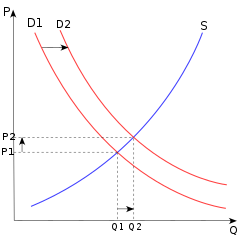
I remember when I was in Marketing 101 in college and we discussed supply and demand. Below is a description from Wikipedia and how it describes the term "Supply and Demand":

The four basic laws of supply and demand are:
If demand increases and supply remains unchanged, then it leads to higher equilibrium price and quantity.
If demand decreases and supply remains unchanged, then it leads to lower equilibrium price and quantity.
If supply increases and demand remains unchanged, then it leads to lower equilibrium price and higher quantity.
If supply decreases and demand remains unchanged, then it leads to higher price and lower quantity.

The price P of a product is determined by a balance between production at each price (supply S) and the desires of those with purchasing power at each price (demand D). The diagram shows a positive shift in demand from D1 to D2, resulting in an increase in price (P) and quantity sold (Q) of the product.

So what am I trying to say, you ask? When was the last time you bought bread, milk or even gasoline and it stayed the same price every time you bought it? Prices for everything are constantly changing depending upon workload, inventory, customer demand and a volume of other factors. When is the last time you had a price change? Just like every other business you need to adjust your price depending upon demand. During busy times, raise your price 10 to 20%. During slow times offer a lower rate. You could even postpone major, time consuming jobs until business is slow provided you get a deposit and the customers equipment is still usable, to a time when you could use the work by offering the the discounted price.

I even adjust my workshop prices depending upon the popularity of that particular location, if you need certain state credits and my costs for that location. Look at my schedule at www.frankpresents.com and see for yourself.

What should you do? Well, if summer is your busy time, increase your price beginning Memorial Day weekend, then drop it back to normal after Labor Day. I've had some of my clients say things like "What if a customer finds out you just raised your price?" Okay, so agree and say "Yes, it's unfortunate how everything is going up, just yesterday it cost me almost $90 to fill up my truck. Hopefully it will go back down to a reasonable price this fall."

There you go, give it a shot and see what happens, yes you may lose some business, but odds are it will be the price shoppers anyway and if you raise your price 10% and lose 5% of your business, Great Job! Less Work, More Money!

Saturday, June 11, 2011

Motivating Younger Employees


There was a time when most people looked at their job as a reflection of who they are as a person. In recent times and more with younger employees, their social life and status amongst their friends dictates who they are, a job is simply a means to help them elevate their social status. Geezers like me believe that our career is who we are and many of us can't comprehend the motivational factors of this younger group. We were driven by the idea of "Improving our financial status so we could take care of our immediate and future needs" People now are driven by "What can I do that will improve my social status". Take a moment to look over "Abraham Maslow's Heirarchy of Needs" and it will explain it. Here is a link: http://psychology.about.com/od/theoriesofpersonality/a/hierarchyneeds.htm

Us old guys used to, and still think as if we are on the bottom two levels. Since our younger folks have not really had to be too concerned about having someplace to stay that they could call their own home, or fear of losing everything or worrying about how to feed their family. They have become a society of people who, no matter what, have all of their basic fundamental needs taken care of, no matter what. Compared to the rest of the world, our poorest would be considered rich. People don't fret that much about whether they have food, they are more concerned about having Direct TV or the latest, greatest pair of basketball shoes or smart phones. This group is motivated by esteem and status.

So Frank, what do I do? You ask. Just understand that this is the way it is and sometimes money isn't the main motivating factor. Provided you have good measurement systems that everyone understands and know how they may be able to improve, set up reasonable goals with rewards for success that may include more free paid time off with friends and family. It may be status or esteem building awards such as a night on the town, paid for by you, or maybe a gift certificate to a nearby mall. Just be creative and realize what you are dealing with and respond accordingly.

I'm sure I'll get the typical responses like "They should be happy they have a job" or "A paycheck should be considered award enough" That worked for me and you other old guys, but does really not apply 100% now.